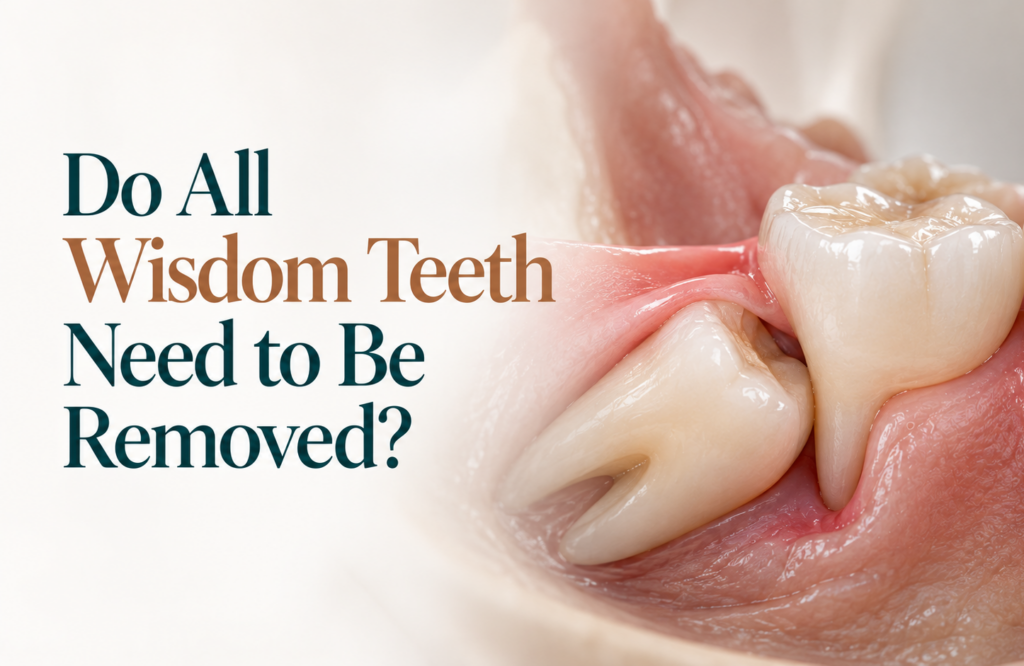
Are you experiencing pain at the back of your mouth and wondering, “Do all wisdom teeth need to be removed?”
The answer is no, not every wisdom tooth needs extraction. Some wisdom teeth grow normally, remain healthy and function just like other molars. Others may become impacted, cause repeated gum infections, develop cavities or damage neighbouring teeth.
The right decision depends on the position of your wisdom tooth, your symptoms, your oral health and what your dental examination and X-rays reveal.
If you’re considering wisdom tooth removal in Madhapur or Hyderabad, here’s what you should know before deciding.
What Are Wisdom Teeth?
Wisdom teeth, also called third molars, are the last permanent teeth to emerge, usually during the late teens or early twenties.
Most people can develop up to four wisdom teeth, although some have fewer or none.
When there is enough space, a wisdom tooth may erupt fully and remain healthy. However, when there isn’t enough room, it may become impacted, meaning it remains partly or completely trapped beneath the gum or jawbone.
An impacted wisdom tooth may grow sideways, tilt towards the neighbouring molar or emerge only partially. These positions can make cleaning difficult and increase the risk of dental problems.
When Does a Wisdom Tooth Need to Be Removed?
Wisdom tooth extraction may be recommended when the tooth causes disease, damages nearby structures or has a problem that cannot be managed predictably with other treatment.
1. Repeated Pain or Gum Infection
A partially erupted wisdom tooth can leave a flap of gum around the visible portion of the tooth. Food debris and bacteria may collect underneath it, causing inflammation or infection known as pericoronitis.
Common symptoms include:
- Pain at the back of the mouth
- Swollen or tender gums
- Difficulty opening your mouth fully
- Bad breath or an unpleasant taste
- Pain while chewing
If infections keep recurring, your dentist may recommend wisdom tooth removal after assessing the cause and position of the tooth.
2. An Impacted or Sideways Wisdom Tooth
An impacted wisdom tooth does not automatically need to be removed. However, extraction may be appropriate if its position creates a significant risk or causes existing problems.
For example, a sideways wisdom tooth may press against the second molar, contribute to decay or make the neighbouring tooth difficult to clean.
A dental X-ray helps assess the tooth’s position and its relationship with surrounding structures before treatment is planned.
3. Tooth Decay That Cannot Be Restored
Wisdom teeth are located at the very back of the mouth, making them difficult to brush and floss effectively.
If a wisdom tooth develops a cavity, the dentist will assess whether it can be restored and maintained. Removal may be recommended when the decay is extensive, the tooth is difficult to access or long-term restoration is not practical.
Not every cavity in a wisdom tooth requires extraction.
4. Damage to the Neighbouring Molar
Sometimes, the bigger concern is not the wisdom tooth itself but the second molar in front of it.
An impacted or partially erupted wisdom tooth may contribute to food trapping, decay or gum and bone damage around the neighbouring tooth.
Early assessment can help identify these problems before they become more difficult to treat.
5. A Cyst or Other Abnormality
In uncommon cases, a cyst or another pathological change may develop around an impacted wisdom tooth.
If an X-ray reveals a suspicious area, further evaluation and treatment may be necessary. Depending on the findings, removal of the wisdom tooth and management of the associated tissue may be recommended.
Can You Keep Your Wisdom Teeth If They Don’t Hurt?
Yes, in many cases.
A wisdom tooth may not need removal if it:
- Has erupted fully into a suitable position
- Is healthy and free of significant decay
- Does not damage the neighbouring tooth
- Has healthy surrounding gums
- Can be cleaned adequately
- Can be monitored during routine dental visits
A fully erupted wisdom tooth that functions normally may be worth keeping.
However, absence of pain does not always mean absence of disease. Some impacted wisdom teeth can develop problems without obvious symptoms. Regular examinations and appropriate X-rays help your dentist decide whether monitoring remains suitable.
What Happens If You Don’t Remove an Impacted Wisdom Tooth?
If a wisdom tooth is causing a problem and is left untreated, possible complications include:
- Repeated gum infections
- Tooth decay in the wisdom tooth or the neighbouring molar
- Gum disease around the back teeth
- Damage to nearby bone or tooth structures
- Cyst formation in uncommon cases
These complications are not inevitable. Some impacted wisdom teeth remain problem-free, which is why an individual assessment is important.
If your dentist recommends monitoring instead of extraction, keep your follow-up appointments and maintain careful cleaning around the back teeth.
When Should You See a Dentist for Wisdom Tooth Pain?
Arrange a dental examination if you experience persistent pain at the back of your mouth, swollen gums, food trapping, repeated infections, difficulty cleaning the area or pain while chewing.
Seek urgent care if you develop rapidly increasing facial or neck swelling, fever with worsening symptoms, or difficulty swallowing or breathing. Breathing or swallowing difficulty can indicate a serious spreading infection and requires emergency assessment.
Do not rely on painkillers or repeated courses of antibiotics as a substitute for identifying and treating the underlying dental problem.
Wisdom Tooth Removal in Madhapur, Hyderabad
If you’re looking for wisdom tooth removal in Madhapur, Hitech City or Hyderabad, the first step is to determine whether extraction is actually necessary.
At COGNIDENT – Psychiatry | Dental Clinic, Madhapur, Hyderabad, our lead specialist Dr. Harshitha Garapati will assess wisdom tooth symptoms, gum health, tooth position and appropriate dental X-rays to help identify the problem and discuss suitable treatment options.
Whether you’re experiencing wisdom tooth pain, have an impacted wisdom tooth or want to know whether your wisdom teeth can be safely retained, a dental consultation can help you make an informed decision.
Book a dental consultation at COGNIDENT if you’re experiencing wisdom tooth pain or need an assessment of an impacted wisdom tooth in Madhapur, Hyderabad.
Frequently Asked Questions
1. Do all wisdom teeth need to be removed?
No. Healthy wisdom teeth that have erupted in a suitable position, can be cleaned properly and are not causing disease can often be retained with regular monitoring.
2. Should I remove my wisdom teeth if they don’t hurt?
Not necessarily. Your dentist will assess their position, condition and risk of future problems. Some symptom-free wisdom teeth can be monitored, while others may need removal if there is evidence of disease or a significant risk of damage.
3. At what age should wisdom teeth be removed?
There is no single age at which everyone should have their wisdom teeth removed. The decision depends on development, tooth position, symptoms, disease and the risks and benefits of treatment.
4. Can an impacted wisdom tooth be left untreated?
Sometimes. If an impacted wisdom tooth is healthy and disease-free, monitoring may be appropriate. Regular follow-up is important because problems can develop later.
5. Can wisdom teeth cause pain in the jaw or ear?
Yes. Inflammation or infection around a wisdom tooth can cause pain that spreads towards the jaw or nearby areas. However, jaw or ear pain can have other causes, so an examination is needed to identify the source.
6. Is wisdom tooth removal always a surgical procedure?
No. Some wisdom teeth can be removed through a straightforward extraction. Teeth that are deeply impacted or positioned awkwardly may require surgical removal.
7. What happens if I delay wisdom tooth removal?
If a wisdom tooth has active infection, decay or is damaging a neighbouring tooth, delaying treatment may allow the problem to worsen. If it is healthy and suitable for monitoring, immediate removal may not be necessary. Follow your dentist’s advice based on your examination.