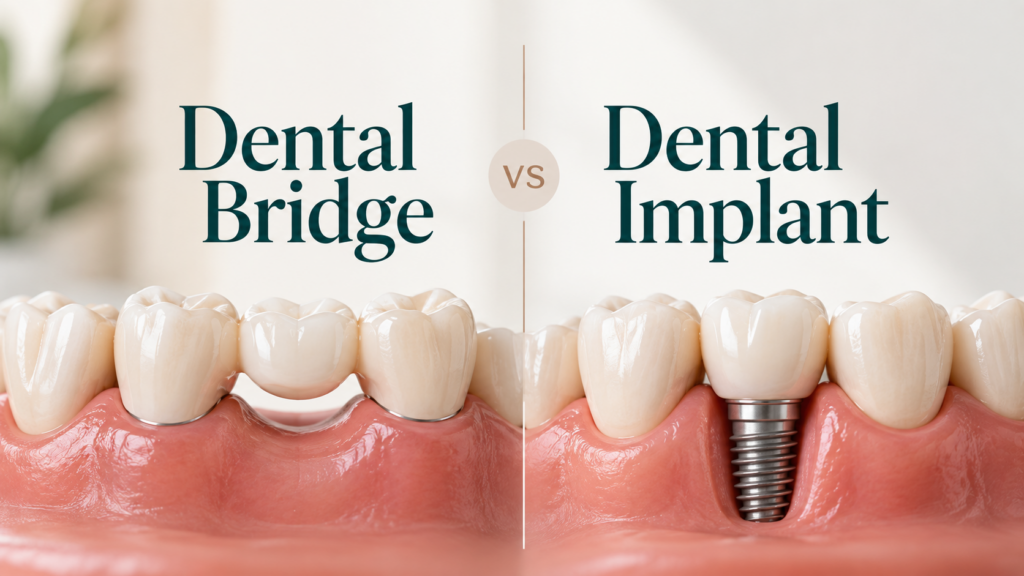
If you have a missing tooth, you may have been told about two common replacement options: a dental bridge or a dental implant.
So, which one is better?
The answer isn’t the same for everyone. A dental implant can be an excellent way to replace a missing tooth, but there are situations where a dental bridge may be a more suitable choice depending on your neighbouring teeth, bone condition, overall treatment plan, preferences and timeline.
Here are some situations where a dental bridge may be considered instead of an implant.
What Is a Dental Bridge?
A dental bridge replaces a missing tooth by using the teeth next to the gap as support. A replacement tooth, called a pontic, is attached to crowns or other retainers supported by the neighbouring teeth.
A bridge can restore:
- The appearance of a missing tooth
- Chewing function
- The shape and continuity of the dental arch
- Some of the changes associated with leaving a tooth gap untreated
Dental bridges have been used successfully for many years, with conventional tooth-supported bridges showing good long-term survival in clinical studies.
When Can a Dental Bridge Be Better Than an Implant?
1. When the Adjacent Teeth Already Need Crowns
This is one of the situations where a bridge can make particular sense.
If the teeth on either side of the missing tooth are already heavily filled, cracked, root-canal-treated or structurally compromised and require crowns, those teeth can potentially be used to support a bridge.
In this situation, placing an implant may not provide the same advantage of preserving completely healthy neighbouring teeth because those teeth already require restorative treatment.
2. When You Want to Avoid Implant Surgery
A dental implant involves placing a titanium implant into the jawbone and allowing it to integrate before the final crown is attached.
A conventional bridge does not require implant placement or implant surgery.
For patients who prefer a non-surgical tooth replacement option, a bridge may therefore be worth considering.
However, whether an implant is appropriate depends on the individual’s oral and general health, bone condition and treatment requirements.
3. When You Need a Tooth Replaced Within a Shorter Treatment Timeline
An implant treatment can involve multiple stages, including implant placement and a healing period before the final restoration.
A conventional dental bridge can often be completed without waiting for implant-bone integration.
The exact timeline depends on the condition of the supporting teeth and gums, the type of bridge and the complexity of the case.
If time is an important factor, your dentist may discuss a bridge as one of the treatment options.
4. When There Isn’t Enough Bone for an Implant Without Additional Treatment
Dental implants require adequate bone for predictable placement.
If significant bone loss has occurred after tooth loss, bone grafting or other procedures may sometimes be required before an implant can be placed.
A bridge does not depend on an implant being anchored into the jawbone.
This doesn’t automatically make a bridge the right choice, but it can be an important consideration when comparing treatment options.
5. When a Less Invasive Bridge Option Is Suitable
Not every bridge requires extensive preparation of the neighbouring teeth.
In carefully selected cases, particularly for certain front teeth, a resin-bonded or adhesive bridge may be considered.
These bridges use a different method of retention and can require considerably less tooth preparation than conventional bridges. However, they are not suitable for every missing tooth or every bite.
6. When Implant Surgery Is Not Suitable Because of Medical Considerations
In some patients, certain systemic health conditions, medications or medical circumstances may make elective implant surgery unsuitable or require it to be postponed until the condition is adequately controlled.
For example, some medical conditions can affect wound healing, infection risk, bleeding or bone healing, which may need to be carefully evaluated before implant placement or any elective oral surgery.
In such situations, a dental bridge may be considered as a non-implant alternative, provided the supporting teeth are healthy enough and the bridge itself is clinically appropriate.
Importantly, this does not mean that every patient with a medical condition cannot have dental implants. The decision should be made after reviewing the patient’s medical history and, when necessary, in consultation with their treating physician.
When Is an Implant Usually Considered?
A dental implant has an important advantage: the neighbouring healthy teeth do not have to be prepared to support the replacement tooth.
For a single missing tooth with healthy adjacent teeth, this can be a significant consideration.
An implant also replaces the tooth independently rather than relying on neighbouring teeth for support.
Missing Tooth Replacement in Madhapur, Hyderabad
At COGNIDENT – Psychiatry | Dental Clinic, Madhapur, Hyderabad, lead specialist DR. HARSHITHA GARAPATI evaluates every case with precision and customizes different replacement options, including dental bridges and dental implants
If you’re searching for dental bridge vs dental implant in Madhapur, Hyderabad, which is better—bridge or implant, or the best way to replace a missing tooth, a personalised examination can help determine which treatment is appropriate for you.
Learn more about the types of dental bridges.
Frequently Asked Questions
Is a dental bridge better than an implant?
Neither is universally better. A bridge may be preferable in certain situations, such as when neighbouring teeth already require crowns or when avoiding implant surgery is important.
Can I get a bridge instead of an implant?
Yes. A dental bridge can replace a missing tooth in many situations, provided the supporting teeth and bite are suitable.
Is a bridge faster than an implant?
A conventional bridge can often be completed in fewer treatment stages because it does not require implant integration with the bone. The exact treatment time depends on the individual case.
Is a dental bridge cheaper than an implant?
It can be less expensive initially in some cases, but costs vary according to the materials, number of teeth involved and additional procedures required.
Can a bridge replace a single missing tooth?
Yes. A conventional three-unit bridge is one option for replacing a single missing tooth. Other bridge designs may also be appropriate in selected cases.